Welcome back to our three part series on Small Ways to Progress Your Surfing.
In the first blog, we explored:
- Foot Strength: The importance of strengthening toes and arches (the “tripod”) for better grip, stability, and control while carving.
- Hip Power and Rotation: Hips are the source of power for turns. The blog details how internal and external rotation are used to generate speed and execute sharp maneuvers while protecting the knees.
- Lower Back Strength: Using powerful back extension (like the Superman pose) to generate upward momentum for the pop up, which is crucial for preventing nosedives on steeper waves.
This time around in the second blog of the series, we’ll be focusing on the small things you can do to improve your pop up – both on shortboards and longboards.
Without further ado, let’s get into it!
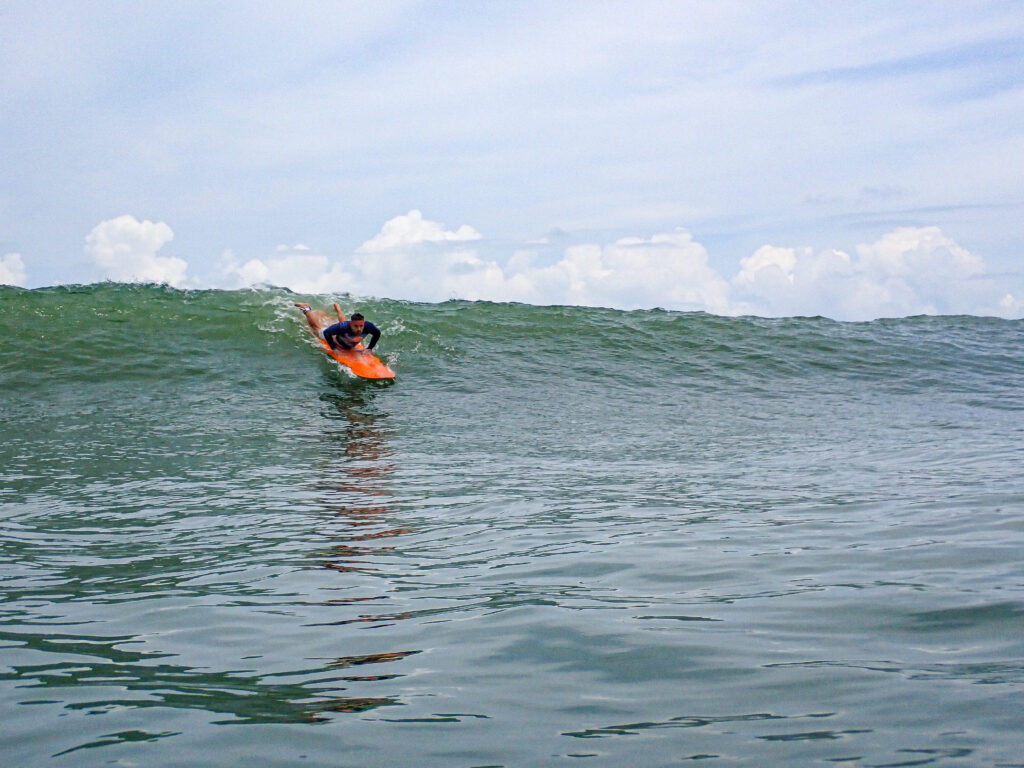
Popping Up With a Longboard
You’ll notice a longer pop up style with longboard surfers. Because their board is longer, typically 8-12ft long, they have the advantage of catching a wave much earlier than someone with a shorter board.
You will see them primarily catching waves at stages 1-2. Check out our blog on the Best Longboard Surfboards for Beginners.
They simply have more time and don’t need to be so explosive when popping up. Especially on a softer wave, they will keep their chest down longer, keeping most of the weight towards the nose of the board to give them more speed.
Once they get close to the speed they want, you’ll see longboarders lift up their chest with their hands on the rails and pause for a brief moment. At this moment, they have their strategy for the wave and their first maneuver in mind.
Then, like a red-eyed tree frog jumping to the next branch, a longboarder will quickly slide their legs up into position. Depending on the steepness of the wave, they have the control, and board length, to place their feet towards the tail or the nose for a quick turn or to generate speed.
On a softer wave, you may see a longboarder fade in one direction and then quickly turn the other direction as the wave steepens. On a steeper wave, they may have their board already positioned in the direction they want to go. As soon as they pop up, they will quickly cross-step or walk towards the nose.
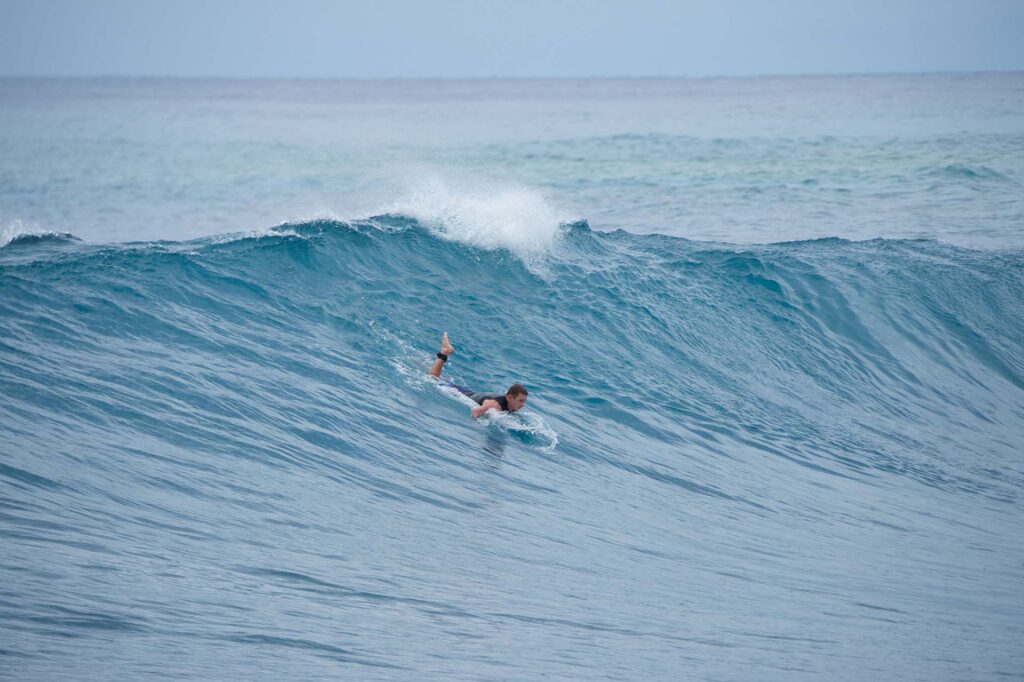
Popping Up With a Shorter Board
To pop up on a shorter board (8 feet or less in length), the strategy is a little more direct.
The window of time to pop up is much smaller because the board length is smaller. This means you have to read the wave, knowing where the best place is to catch enough energy to propel you forward.
Most shortboarders will time their pop up within stage 3 of a wave. The wave is just about to crest, getting close to the peak of its power. Because this is close to the critical section, they have to explosively pop up to be riding as soon as possible. Later, we’ll talk about how pushups can help with this.
You’ll see professional shortboarders quite literally riding in the sweet spot of stages 3 and 4 of a wave. This is where they can get the most speed to perform their spectacular maneuvers. Because their board is short, they need to be in the critical section. If they go too far out on the shoulder, they won’t have enough floatation and speed to bring themselves back.
With your first surf lesson, you may have started learning the popup in five steps: hands under chest, lift the chest, bring the back foot up, front foot up, and stand up with knees bent. Now those five steps will feel like one step: one fluid motion.
Remember that the waves and your board choice influence how you pop up. When you pass the beginner phase of surfing and have a solid pop up technique, then you start to finesse specific movements for specific situations. It’s like learning the notes of a music scale to then create a song.
Small, Daily Movements Make All The Difference
Whether you’re into yoga or not – a lot of the movements, postures, and flows will play an undeniable role in improving your pop up. Check out our blog here on yoga for surfers and mobility!
Does this mean in order to get better at surfing you need to start doing yoga? Not necessarily. Would it help? Definitely.
There are plenty of small movements that you can do a few times a day while at home, on break from work, or wherever; that will help condition your body and your muscles to perform more efficient pop ups.
Bhujangasana: Cobra Pose
A good strengthening and mobility exercise is to perform a back extension into a cobra pose.
Lie down on your stomach, firm your hips and legs onto the floor, and then lift your chest as high as you can. Keep your hands in front of you to lightly push them into the floor to extend your back a few inches further.
First start slow, you really want to emphasize getting your chest as high as possible. You want to train your erector spinae muscles, the muscles running along the spine, to really squeeze at the top of your range of motion.
Next, continue to flex your back and allow your hands to help those muscles get the chest a little higher. As you progress, your hands assisting to lift your chest can push lighter and lighter, strengthening your spinal muscles.
Balance with Transferring Your Weight
As you progress into bigger waves you will have to drop into steeper wave faces.
A common mistake is keeping too much weight on the back foot, leading you to slide out like a rug being pulled out from under your feet. You will also learn that the position of your hips controls how your weight is distributed, as well.
Too much weight on the front foot and you either dip the nose of your board in the wave or have no control to turn. Your front leg can be seen as your gas pedal to go faster on a wave. With what we have discussed earlier, keep in mind the three points on each foot, as well.
But there’s more than just “pushing” on the leg here. You are shifting your weight by leaning with your hips into your front leg, shifting your center of mass forward to match how fast, or even to go faster, then the speed of the breaking wave.
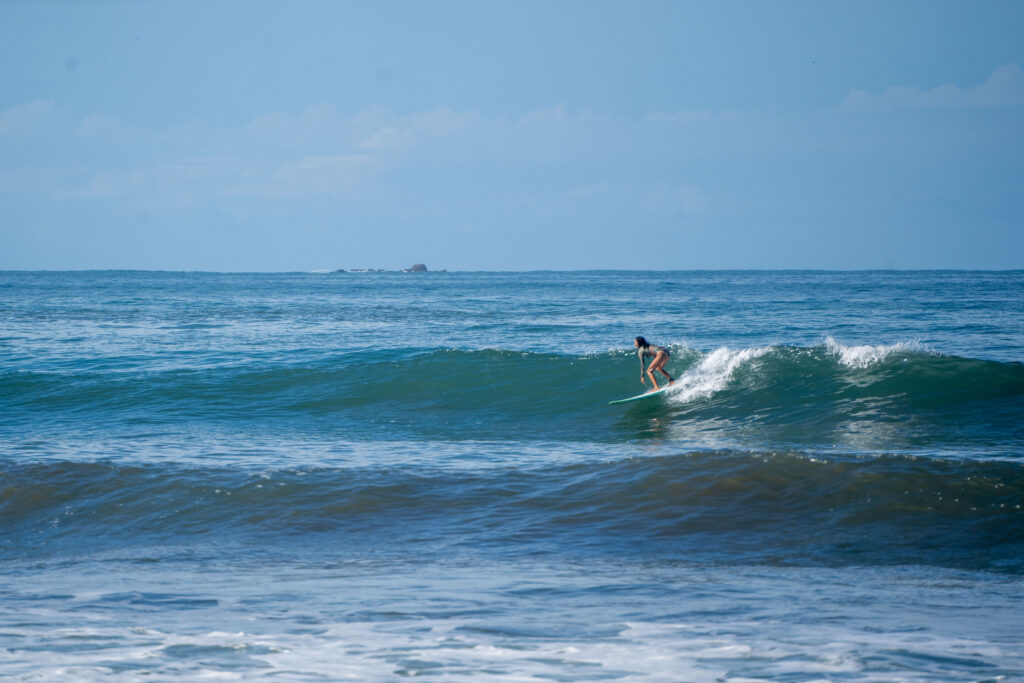
Get on the Good Foot
In sports there’s a saying of someone being caught “flat footed.”
This means that a player was caught having too much weight on their heels and they stumbled or were caught off guard. Just like what we said with our feet, you still want to keep your weight on the forefoot, or ball of the front foot, to stay reactive.
To gain more speed while riding a wave, the basic way is to lean your hips/torso more towards your front knee. Your leg is isometrically holding and staying loaded to either absorb more of your weight to go faster, or to push off for a turn.
Isometric strength is about how much force you can put onto a contracted muscle without moving the joint, AND how long you can hold it. Typically with riding bigger waves you are also riding a longer wave. The longer the wave, the more your legs have to work.
With point breaking waves, like at Pavones in Costa Rica, surfers can ride a wave for one minute or longer. This requires a lot of endurance and stamina. You’ll hear veteran surfers say that the wave is a leg burner, meaning their muscles were constantly working long enough to build up lactic acid.
So, there’s a few things to focus on with training your legs for advancing your surfability:
- Balance with more than 50% of your weight on one leg
- Isometrically holding your legs in a flexed position
- Building up your leg’s threshold of muscular endurance
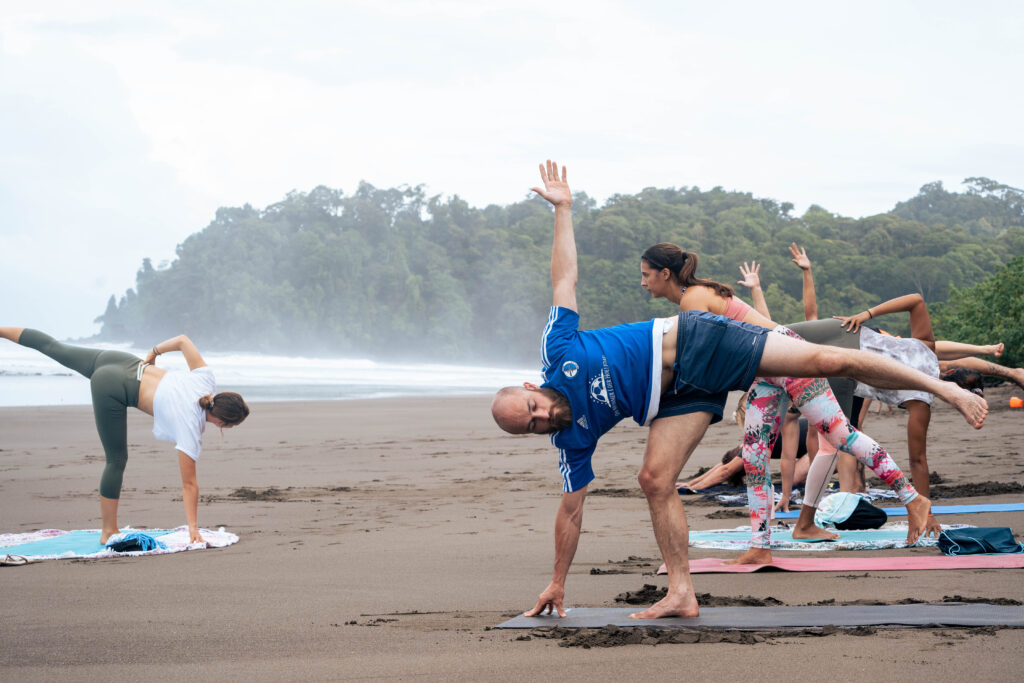
Stoking the Agni in Your Legs
Luckily, yoga postures and transitions are a perfect way to work your legs for surfing.
Agni translates to fire in Sanskrit, be sure to warm up the joints and muscles beforehand. Agni is actually a really cool principle in the ancient science of Ayurveda – Pilar has a blog all about it!
When completing these flows, it’s important to have some blocks and props for your hands to help you balance.
First practice slowly, meaning really feel your weight being transferred onto the single leg balance posture. Don’t be ashamed if you have to walk your foot on the ground during the transition, that’s part of the training!
You will notice more and more how to use your hips and upper body as the counterweight to transition into balance. Think of your hips as the fulcrum with your legs on one side and upper body on the other side of a seesaw.
As your mind and body become accustomed to the postures and transitions, you can find more of a challenge by not launching your body into the single leg balance postures. This means that through the whole transition you are in control.
You can also transition from the single leg back to the two leg postures, reversing the flow. You will feel your legs burn for sure!
Stay Tuned For The Third And Final Blog Of The Series!
But be sure to check back in SOON for part three of this three-part blog series on small things that make a big difference with your surfing progression.
Just to recap, in this second blog post we’ve covered:
- Pop Up Techniques by Board Type: Longboarders can catch waves earlier and use a less explosive, frog-like leg slide into position, whereas shortboarders must use a direct, explosive one-fluid-motion pop up to catch waves at their peak power.
- Physical Conditioning and Mobility: Specific exercises like the Cobra Pose (Bhujangasana) strengthen the spinal muscles required to lift the chest high during a pop up, while yoga-inspired single-leg balance flows build the isometric strength and endurance needed for longer rides.
- Weight Distribution and Reactive Stance: To maintain speed and control, surfers must avoid being flat footed by keeping weight on the forefoot and shifting their center of mass forward using their hips to match the speed of the breaking wave.
We look forward to continuing and building our understanding in the next blog! There, we’ll start by covering the small things we can do to improve our paddle-out.
For First-Time Surfers
You Don't Need Experience. You Don't Need Gear. You Just Need This.
Our free 5-day email course that reveals the 5 myths keeping beginners at "I'm not ready" instead of catching their first wave and finding inner peace-and how to overcome them fast.
The Newbie Surf + Yoga Camp Kickstarter
Bust the 5 biggest myths about going to a surf and yoga camp so you can stop procrastinating and start catching waves - with our FREE 5-day email course.



How to Teach Yourself How to Surf
Words by Carly Stoenner
Learning to surf is more than standing on a board in the ocean. At its core, surfing is a physical, spiritual, and communal practice…
Is Surfing a Sport? And Why it Matters
Words by Carly Stoenner
To quickly answer this question, yes, surfing is a sport according to the International Olympic Committee (IOC). Surfing officially debuted as an Olympic sport…
The Endless Summer(s) Surf Movies
Words by Bodhi Surf + Yoga
American society is greatly influenced by its media outlets, especially movies. Every now and then there comes along a movie that although is a…