
The True Cost of the Beachfront View: Rethinking Surf Tourism and Coastal Development
At Bodhi Surf + Yoga, some of our most profound conversations don’t happen in the water — they happen around the table at our communal breakfast and lunches before and after the boards are rinsed and yoga has been completed.
Lately, the conversation topic has been about the massive developments popping up in other global surf hubs. Guests ask about the luxury resorts being built right on the sand, or the government-funded mega-projects designed to turn quiet coastlines into tourist engines. They wonder why the Southern Zone of Costa Rica feels so fundamentally different.
Our co-founder Travis often guides this conversation toward a hard truth about the surf travel industry: we have confused “convenience” with “connection”.
For decades, the ultimate dream of a surf vacation was to wake up, step off your hotel balcony, and immediately touch the sand. Whether it is a $20-a-night party hostel or an $800-a-night luxury eco-resort, the desire to build right on the break is universal. But we are realizing that the price tag of the room doesn’t dictate its sustainability. An expensive resort sitting on top of a destroyed mangrove ecosystem is just as damaging as a budget camp dumping untreated wastewater.
The difference between being a coastal “consumer” and a “Bodhi Surfer” (an Engaged Ocean Guardian) requires us to completely rethink how, and where, development is permitted. Check out Travis’ blog where he dives deeper into this philosophy and how it’s embedded into our business DNA.
The “Surf City” Model vs. The Southern Zone Ethos
Right now, we are seeing entire coastlines rebranded and paved over. Look at the massive infrastructure push behind “Surf City” in El Salvador, or the rapid commercialization of certain breaks in Southeast Asia. These projects prioritize top-down efficiency, mass-market volume, and immediate beachfront access. They pour concrete highways straight to the sand to make the journey as frictionless as possible.
But friction in nature is a boundary. When you remove it, the ecosystem collapses.
It is undeniably beautiful to sit by a luxury infinity pool and watch the waves break. But what is the real cost of that convenience? If building that pool required clearing primary coastal rainforest, disrupting sea turtle nesting grounds with light pollution, and starving the local reef of natural sediment flow, the price is simply too high.
Costa Rica’s Southern Zone operates on a different ethos. Here, we respect the Zona Marítimo Terrestre (Maritime Zone law), which strictly protects the first 200 meters of the coastline from private development.
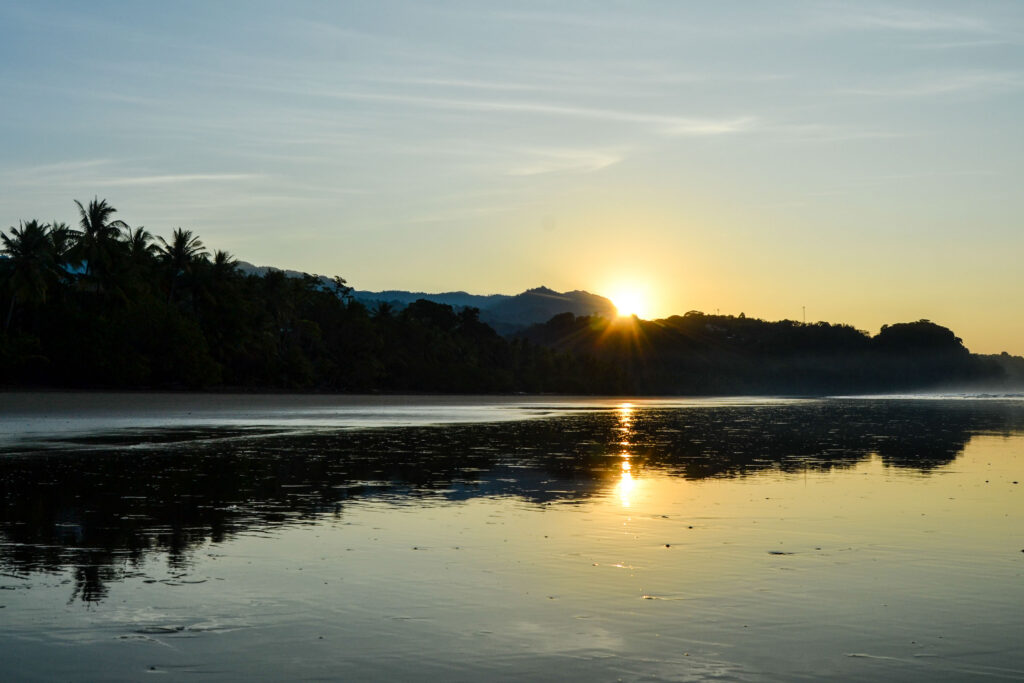
At Bodhi Surf + Yoga, we aren’t located on the beach — and we never want to be. Our lodge is set back about 1 mile (1.5km) in the heart of the community of Bahía Ballena. Our guests walk a short dirt path through the jungle entrance to reach the waves of the Marino Ballena National Park.
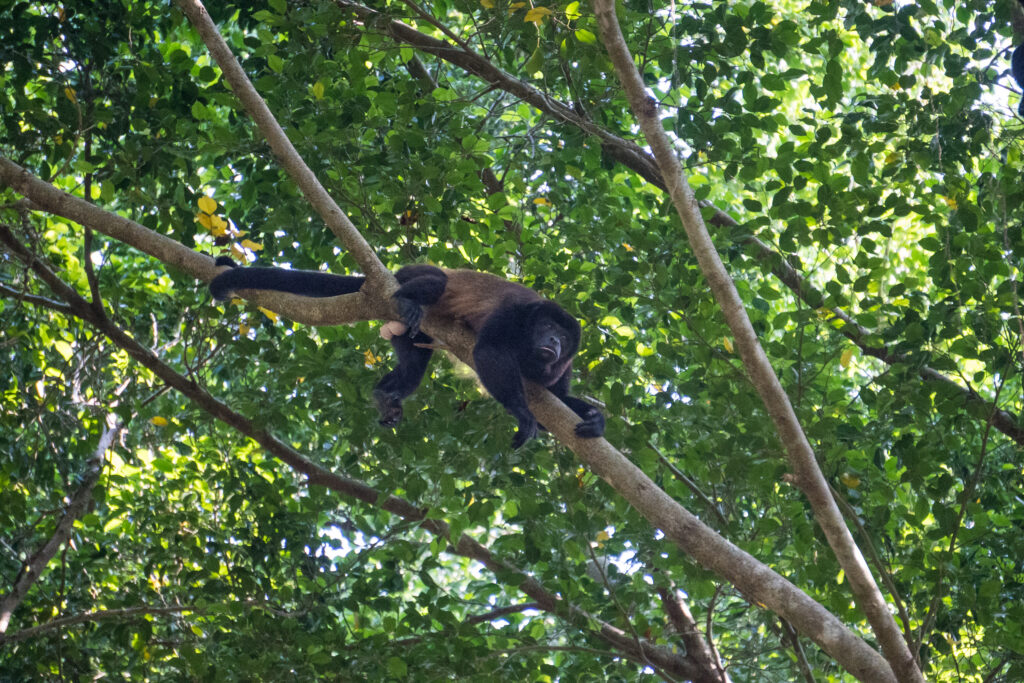
That walk isn’t a minor inconvenience; it is a vital ritual. It allows the howler monkeys, the sloths, and the scarlet macaws to keep their homes, and it reminds us that the beach is a wild sanctuary, not a hotel lobby.
The 5 Whys: Deconstructing Coastal Development
To understand why beachfront surf tourism needs a profound recalibration, let’s apply the “5 Whys” logic to the modern surf resort:
- Why do resorts build right on the sand? Because consumers demand the convenience of an unobstructed ocean view and immediate water access.
- Why is that a problem? Because the immediate coastline is the most fragile part of the ecosystem. It is the buffer zone for storm surges, the nesting ground for marine life, and the filtration system for the reef.
- Why doesn’t a high price tag fix this? A luxury “eco-resort” built on the beach often causes more damage than a small inland hostel. High-end amenities require massive energy grids, extensive water consumption, and heavy footprint construction that permanently alters the dune architecture.
- Why is the Southern Zone of Costa Rica different? Because development here has historically been forced to yield to nature. The creation of the Marino Ballena National Park ensured that the coastline itself remains a protected biological corridor, rather than real estate.
- Why does this matter for your surf trip? Because every dollar you spend is a vote for how coastlines should be treated. When you choose a lodge set back from the beach, you are voting to keep the shoreline wild.
Want to learn more about our intentional travel philosophy? Head over to our responsible business hub!
The Osa Advantage: Biological Medicine for the Soul
When you are planning your next trip, remember that the location of your bed matters just as much as the quality of the wave. While parts of northern Costa Rica are battling their own overdevelopment issues, the Osa Peninsula and the Southern Zone remain a sanctuary of intentionality.
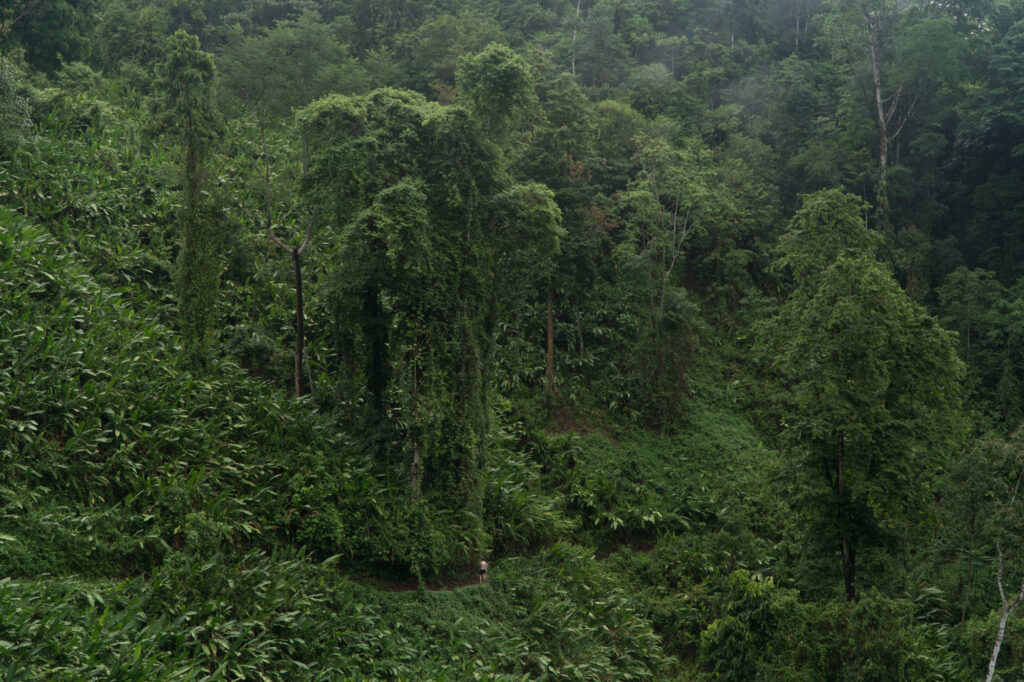
The New York Times recently named the Osa Peninsula the #4 destination in the world for 2026 — and the #1 destination in all of Latin America. They didn’t choose it for high-rise beachfront hotels. They chose it because it is a masterclass in stewardship. This region holds 2.5% of the world’s biodiversity in just 0.03% of the planet’s surface.
At Bodhi, we view this untamed landscape as “Biological Medicine”. When you are surrounded by this much life, your nervous system resets. The noise of a busy, paved-over world is replaced by the rhythm of the jungle. You aren’t just “going on vacation”; you are entering a space of longevity and restoration.
Check out our recent blog on Osa’s “invisible highway” – a critical biological “superhighway” existing beneath the very waves that we surf.
“I was not seeking transformation, it wasn’t something I thought I needed. It just happened. A continuous string of moments with the Bodhi crew, with new friends, with the Uvita community, with myself, the wildlife, the jungle and the rain, with Playa Chaman and the ocean, these all saturated my mind, body, and soul… There is nothing to hold onto because, contrary to my intentions, these two weeks weren’t spent stacking up knowledge and skillsets. For two weeks, I simply woke up and participated in the beautiful life set out before me in community with the people around me.” — Read the full review here!
More Than an “Eco” Label: The B Corp Peace of Mind
Being a B Corp certified organization means we are legally and ethically held to a higher standard. We are audited on our environmental footprint, our governance, and how we interact with our local environment. We are incredibly proud to be a three-time certified B Corp — and the first surf and yoga camp in the world to achieve this milestone.
In our most recent 2023 recertification, we achieved a B Impact Score of 127.9. To put that into perspective, the median score for an ordinary business is just 50.9, and the minimum to qualify is 80.
While mass-market resorts often focus on the look of sustainability—bamboo straws and organic cotton sheets—our certification focuses on the impact of our physical presence. Because we are set back from the fragile coastline, we have the space and infrastructure to implement real change. Recently, while achieving Costa Rica’s Ecological Blue Flag Award (Bandera Azul) for Climate Change, we installed solar panels that now power 70% of our lodge. We started collecting rainwater, leading to a 30% reduction in our water consumption, and successfully offset 15 tons of carbon.
We view the community and the environment as our primary stakeholders. This commitment has earned Bodhi Surf + Yoga the “Best for the World” recognition in the Community category multiple times (2017, 2018, 2019, 2021, and 2022). When you book a Bodhi Session, a portion of your fee goes directly into local initiatives. In a single year, we raised over $16,000 for a Marine Conservation & Education Center and invested hundreds of hours into community projects alongside partners like Costa Rica Coral Restoration.
We believe that true sustainable tourism means investing in the town that hosts you and the reefs that build your waves, not just extracting the view. When you choose to vacation with a B Corp, you are rejecting a business model that values profits above the planet.
Know Your Depth: Moving Beyond the Transaction
When you stay at a beachfront mega-resort, surfing often becomes a superficial transaction. You rent a board, catch a few waves, and head back to the infinity pool. The ocean is treated merely as a beautiful backdrop for a vacation.
At Bodhi, we challenge our guests to Know Your Depth. This means understanding that the waves you ride are intrinsically linked to the health of the coastline you are standing on. It means recognizing that the sand under your feet, the mangrove forests buffering the river mouths, and the underwater coral architectures are all part of a delicate, interconnected system.
When our guests walk that jungle path to Marino Ballena National Park, they aren’t just commuting to a surf break. They are walking through a living, breathing ecosystem. By understanding the depth of this connection, the experience transforms. You stop looking at the ocean as a playground and start seeing it as a sanctuary that requires your active stewardship. You evolve from a passive consumer into an Engaged Ocean Guardian.
Conclusion: Investing in the Places We Love
A vacation is what you take when you want to escape your life. Guardianship is what you practice when you want to change it.
As travelers, we have to let go of the idea that we are entitled to a bedroom on the sand. We have to embrace the walk through the jungle. We have a choice: we can support a model of “progress” that paves over the sacred to make our walk to the water a little shorter, or we can invest in the Southern Zone — where the coastline is wild, the community is thriving, and the destination is actually worth protecting.
Are you ready to become an Ocean Guardian?
Frequently Asked Questions about Ethical Surf Travel
What is the problem with beachfront surf resorts?
Building directly on the beach destroys highly sensitive coastal ecosystems, including mangrove forests, dunes, and sea turtle nesting grounds. Even expensive, “luxury” resorts cause severe ecological fragmentation when built too close to the tide line.
What is the “Surf City” development model?
It is a top-down, infrastructure-heavy approach to surf tourism that prioritizes mass-market volume and convenience (like paved roads to the sand and beachfront mega-camps) over ecological preservation.
How does Bodhi Surf + Yoga protect the coastline?
We adhere to a “Small is Beautiful” philosophy and are intentionally located off the beach, within the community of Bahía Ballena. Our guests walk through the jungle to access the Marino Ballena National Park (check out the video above), ensuring the immediate coastline remains wild and protected. We also donate to Costa Rica Coral Restoration ensuring our business contributes to protecting and restoring the coastline.
What is the Maritime Zone law in Costa Rica?
The Ley de la Zona Marítimo Terrestre protects the first 200 meters of the coastline from the high tide mark. The first 50 meters are strictly public and cannot be built upon, ensuring beach access for everyone and protecting the immediate shoreline.
Ready to experience the beauty of an untamed coastline? Explore our upcoming Bodhi Sessions or View our Sustainability Initiatives report to see how we protect the waves we love.

For First-Time Surfers
You Don't Need Experience. You Don't Need Gear. You Just Need This.
Our free 5-day email course that reveals the 5 myths keeping beginners at "I'm not ready" instead of catching their first wave and finding inner peace-and how to overcome them fast.
The Newbie Surf + Yoga Camp Kickstarter
Bust the 5 biggest myths about going to a surf and yoga camp so you can stop procrastinating and start catching waves - with our FREE 5-day email course.


How to Teach Yourself How to Surf
Words by Carly Stoenner
Learning to surf is more than standing on a board in the ocean. At its core, surfing is a physical, spiritual, and communal practice…
Is Surfing a Sport? And Why it Matters
Words by Carly Stoenner
To quickly answer this question, yes, surfing is a sport according to the International Olympic Committee (IOC). Surfing officially debuted as an Olympic sport…
The Endless Summer(s) Surf Movies
Words by Bodhi Surf + Yoga
American society is greatly influenced by its media outlets, especially movies. Every now and then there comes along a movie that although is a…