
Conscious Travel: The Heartfelt Invitation to Step Out of the Noise and Travel Differently
If you have spent any time researching a vacation recently, you have likely been hit with an exhausting tidal wave of marketing terminology. Your social media feeds insist that you must look for Ecotourism. Travel industry articles urge you to travel Sustainably. Wellness influencers promise Transformational experiences, and boutique booking platforms assure you that your next trip has to be Regenerative.
For those seeking a genuine break from a busy, digitally overloaded life—where the constant ping of Slack notifications and the glare of back-to-back video calls never seem to end—this linguistic soup creates far more noise than clarity. When you are sitting at your desk on a Saturday afternoon, feeling the heavy, low-grade hum of chronic burnout and navigating a major life transition, you do not need academic definitions.
You need to know if a travel experience is real, or if it is just clever marketing. What do these words actually mean, and how did we get here? How do these philosophies dictate the way you step off a plane, take a deep breath of tropical air, and interact with a local community?
To understand where conscious travel is going, we have to look back at how our collective relationship with the planet—and ourselves—has evolved over the last four decades.
The Evolutionary Timeline of Conscious Travel
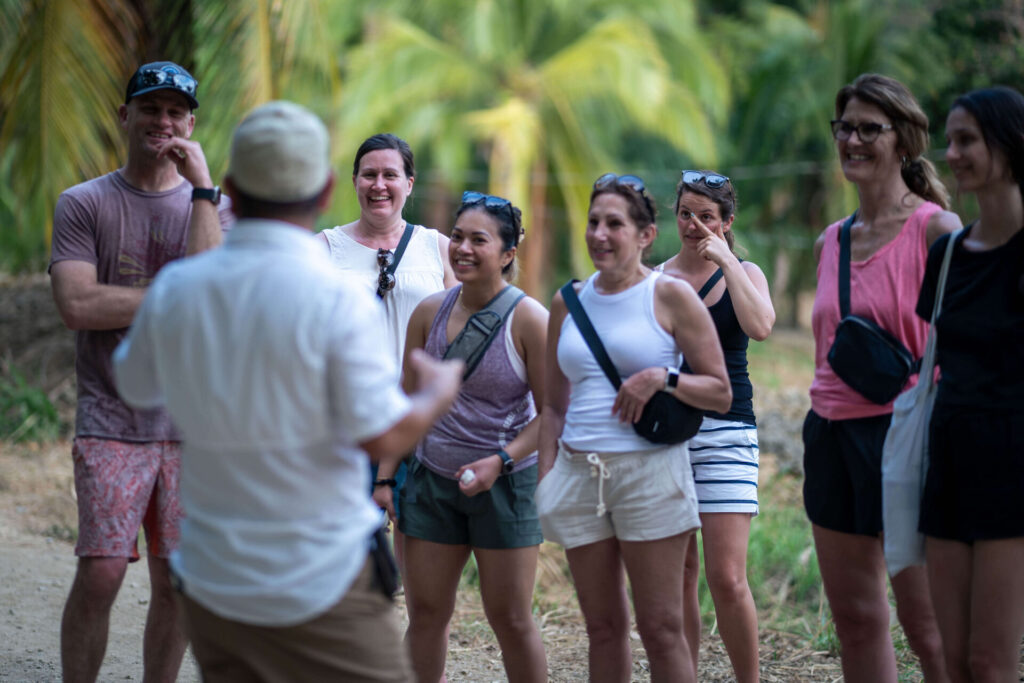
The history of responsible travel is not a series of passing fads. Instead, it is a steady, slow-moving expansion of human awareness. Each era built upon the lessons of the last, shifting travel from an extractive, consumer-driven behavior to a deeply collaborative, healing practice.
1. Ecotourism: The Nature-First Awakening (1980s)
The journey began as a direct counter-response to the rise of mass-market, mega-resort tourism that bulldozed pristine coastlines and commodified local cultures. In the mid-to-late 1980s, Ecotourism burst into the global market. Codified by early conservationists, it focused strictly on travel to undisturbed natural areas to admire, study, and appreciate nature and wildlife.
The metric of success was simple: species preservation and ecological protection. Travelers were encouraged to step lightly. The prevailing vibe of this era was perfectly encapsulated by the famous phrase: “Take nothing but pictures, leave nothing but footprints.”
- The Pro: It funneled critical financial resources directly into national park systems and wildlife refuges, proving that nature was worth far more alive and intact than extracted.
- The Con: It was incredibly vulnerable to greenwashing. Mass-market resorts quickly realized they could slap a green leaf on their logo without fundamentally changing their environmental impact or labor practices. In addition, it often left the human element—the local communities—completely out of the equation.
2. Sustainable Tourism: The Systemic Blueprint (1990s)
By the time the 1992 United Nations Rio Earth Summit concluded, the global community realized that isolating nature was not enough. Travel needed a holistic operational framework. Sustainability introduced the “Triple Bottom Line” framework: a delicate balancing act between environmental protection, economic viability, and socio-cultural integrity.
- The Pro: It standardized international certifications and created clear operational guidelines for waste management, water conservation, and carbon mitigation.
- The Con: At its worst, sustainability is a low bar. To “sustain” literally means to maintain a baseline. In a world where global ecosystems are already severely degraded, maintaining the status quo is simply keeping a broken system sick.
3. Community-Based Rural Tourism: The Grassroots Pivot (2000s)
As the travel industry grew, a glaring systemic flaw emerged: “leakage.” Billions of tourist dollars were being spent in developing nations, but the vast majority of that capital leaked right back out to multinational corporate headquarters.
Community-Based Rural Tourism (CBRT) emerged as a radical grassroots pivot. It moved the local community from the background of a traveler’s photo to the head of the boardroom table, ensuring locals retain the direct benefits of the tourism assets.
- The Pro: It keeps wealth exactly where it is generated and prevents the corporate sterilization of beautiful, culturally rich places.
- The Con: Pure CBRT initiatives historically struggled to scale or reach international travelers without the support of dedicated external partners.
4. Transformational Tourism: The Internal Revolution (2010s)
By the mid-2010s, a new crisis was brewing: chronic digital burnout. Travelers were desperate to feel something real again. This gave birth to Transformational Tourism, a movement dedicated to intentionally designing travel experiences that spark an internal paradigm shift.
(Read more on our specific stance here: Why We Don’t Sell Transformation (And Why You Shouldn’t Buy It))
- The Pro: It recognizes the traveler as a whole human being, prioritizing mental wellness, self-care, and mindfulness.
- The Con: Without a strong ethical anchor, it risks turning a vulnerable foreign community into nothing more than an exotic backdrop for a wealthy traveler’s personal epiphany.
5. Regenerative Tourism: The Active Healer (2020s)
When the global pandemic brought travel to a grinding halt, the industry faced a harsh truth: net-neutral sustainability was no longer enough. We entered the era of restoration.
The goal of regenerative travel is to leave a place—its soil, its water, its wildlife, its economy, and its people—fundamentally healthier, more resilient, and more vibrant than it was found.
- The Pro: It transforms the traveler from a passive consumer into an active steward.
- The Con: Because it requires radical operational transparency, it is incredibly easy for lazy marketing departments to co-opt it as a trendy tagline without doing the actual groundwork.
Similarities, Differences, and the Core Paradox
When you look at these models, a striking paradox emerges. The first three (Eco, Sustainable, CBRT) focus almost entirely on fixing the external world. The fourth model (Transformational) turns its lens completely inward. The fifth (Regenerative) tries to tie it all together but often gets bogged down in heavy, academic, scientific terminology.
This leaves conscious travelers stuck in a frustrating middle ground. You are forced to choose between rigid, clinical ethical trips or high-priced luxury wellness retreats that do absolutely nothing for the local neighborhood.
The Bodhi Synthesis: We Don’t Fit in a Single Era
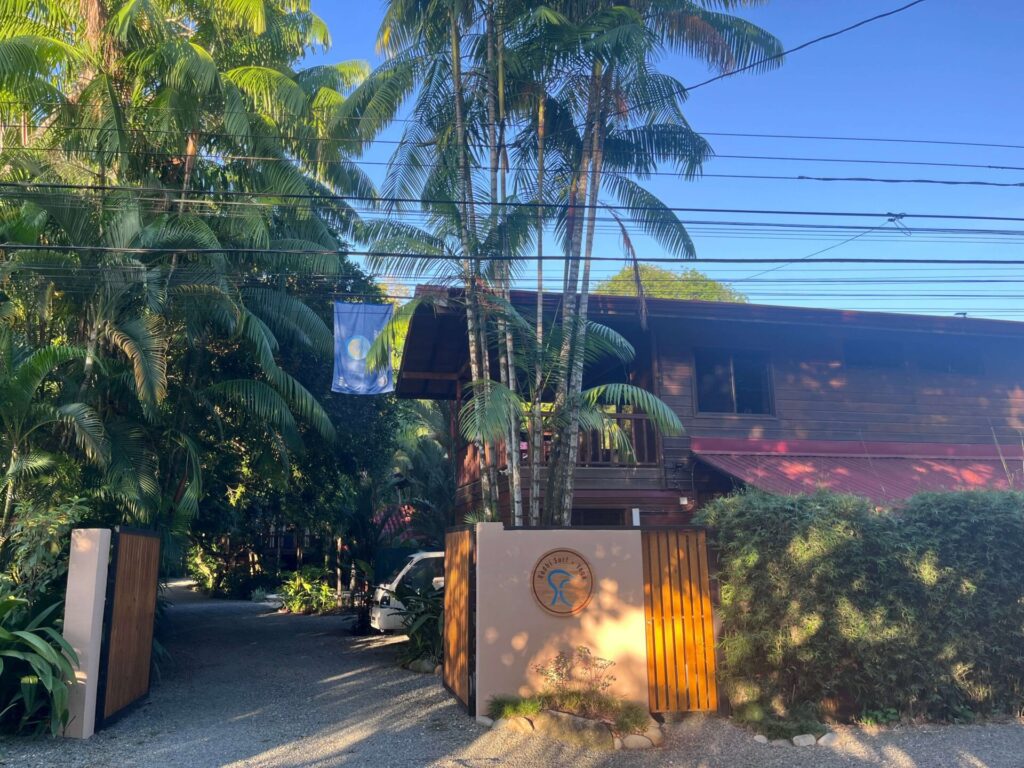
At Bodhi Surf + Yoga, we do not fit into a single category because we pull the absolute best elements from all of them to create a singular, unified way of being. We operate at the exact cultural intersection where Transformational Tourism meets Regenerative, Community-Based Travel under a rigorous, certified B Corp framework.
Here is exactly how those worlds connect when you step foot inside our lodge.
1. We Create the Conditions for Shifts, Not “Guaranteed Transformation”
As we have shared before, we do not sell transformation. We do not package a “new you” into a neat 7 or 14-day itinerary, and we certainly do not believe that personal epiphanies can be guaranteed by paying a deposit. Instead, we see any internal shift as a natural, beautiful byproduct of being in the right environment with the right intentions.
We use the visceral, physical challenges of surfing and the grounding practices of yoga to create a space for you to slow down and listen. When you arrive exhausted from the digital grind and burdened by chronic stress, you do not need a forced curriculum. You need breathing room.
Once you learn to regulate your nervous system on the mat using deep breathing techniques, or catch an unbroken green wave on your own, your awareness naturally opens up.
And that is exactly when we redirect that new energy outward. We do not let it stay entirely self-focused. We connect your personal reset to the health of the ocean, educating you on how to step into the role of an Engaged Ocean Guardian. Transformation is not the goal; connection is. 🙏
2. We Practiced Radical Regeneration Before It Had a Name
Regenerative travel is a core operational boundary for us. It started from the literal ground up. When we first bought the piece of land that Bodhi Surf + Yoga now sits on, it had been completely stripped. Aside from a single Cenicero tree and a Mango tree—which both still stand proudly on our property today—it was bare, dry earth.
Over the years, we did not just build a lodge; we actively regenerated a thriving ecosystem, planting countless native plants and trees to invite the jungle back home.
This commitment to regeneration over extraction is also why we made a deliberate choice when developing the lot next door. As we detailed in our post on Why We Didn’t Build More Bungalows, the standard business move would have been to maximize our capacity and build more rooms. Instead, we built a quiet meditation garden. We chose to prioritize green space, wildlife corridors, and a place for our guests to simply breathe, adhering strictly to our “Small is Beautiful” philosophy where we host a maximum of 10 guests per week.
But as our roots grew deeper into the Costa Rican soil, we realized our responsibility could not stop at the shoreline. For years, we supported a variety of amazing community and environmental projects, but we eventually realized that true impact requires a focused, sustainable commitment. If we were going to truly cultivate a global community of engaged ocean guardians, we had to look beneath the surface. So, we made a choice to focus our primary efforts on one vital thing: the coral reefs.
The reef sits at the absolute center of the place we call home. It sustains the rich marine life within the Marino Ballena National Park, which in turn sustains our local community. For those of us learning to surf, the reef is so much more than a beautiful backdrop. It shapes the very waves we ride and protects our coastline, proving that surfing is far more than a sport—it is a relationship with a living, breathing ecosystem. 🌊
Today, this commitment is woven into every single week of our season. Through our Traveler’s Philanthropy Program, a portion of every Bodhi Session fee goes directly to support active coral farming and scientific efforts.
More importantly, our traveler philanthropy is not just an abstract concept. When you stay with us, you get to meet the people doing the actual work. Our guests have the unique opportunity to visit the local restoration lab hosted by Costa Rica Coral Restoration, witness the micro-fragmentation process up close, and ask real questions. For many, stepping out of the surf and into the lab to see the tangible results of their visit is the most profound Pura Vida moment of their entire vacation. It is our way of ensuring that when you visit, you are not just sustaining the environment—you are actively helping to rebuild it.
3. Community-Based Travel is Part of Our DNA
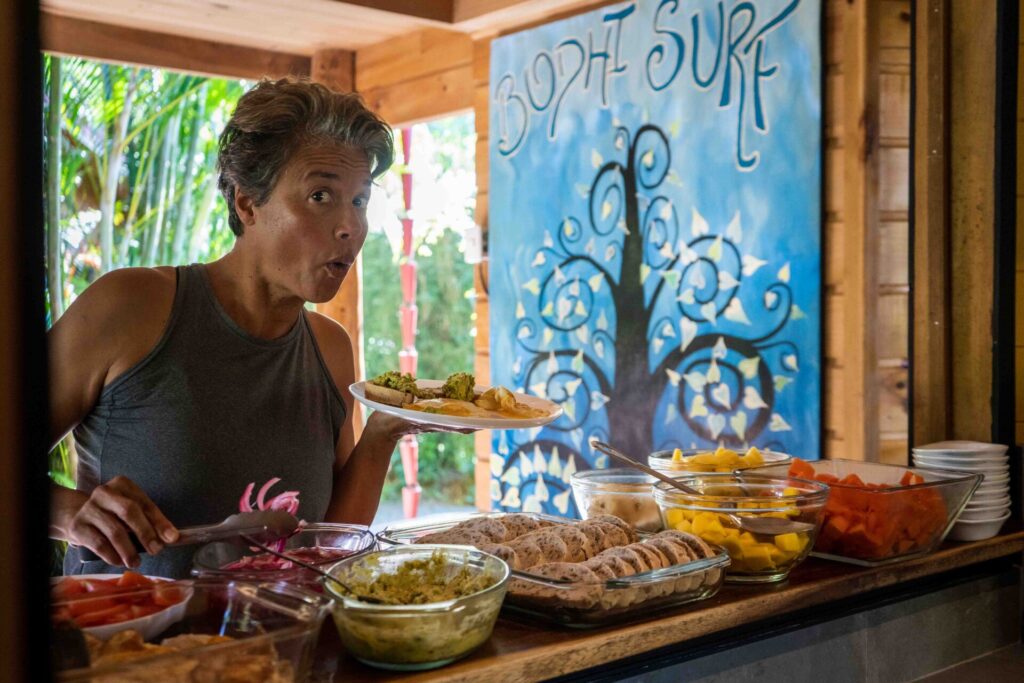
We are profoundly grounded in Uvita, Bahía Ballena. Our deep respect for this place is anchored in the history of Uvita. When you stay with us, you are not a consumer insulated inside a generic eco-resort; you are a welcomed friend inside a thriving, warm local community.
We do not construct artificial cultural interactions; we actively integrate you into the daily life of our town. This looks like partnering with local cultural guides for a guided walking tour through the neighborhood, or sending guests on an authentic, hands-on coconut tour with our neighborhood partners.
It is also the reason we intentionally do not offer all-inclusive meal plans. We want you to walk outside our gates, explore the local sodas (traditional restaurants), buy a fresh, cold pipa (coconut water) on the beach, and directly support the families and small businesses that make up our home.
This is how we share the deep, systemic connection between yoga and sustainable living—by translating mindfulness on the mat into mindful, respectful economic support for our neighbors. We teach you the true depth of Pura Vida—as a living philosophy of resilience, gratitude, and communal care.
Listen to the Guest: Real Stories of Synthesis
The truth of this synthesis lives entirely in the raw, unedited voices of our Bodhi Fam—past guests who have experienced the intersection of these travel philosophies first-hand.
Embracing the Natural World
“Uvita is absolutely stunning—the nature, the animals, especially the BIRDS! Every day felt like Christmas morning, waking up to their songs and peeking out the window to watch them… Bodhi is an oasis, with well maintained beautiful grounds next to a jungle, making for some great listening and viewing of tropical birds and animals nearby.”
Engaging the Community
“Bodhi walks their talk. If you want to experience community and connectedness, this is the place for you. They have created an experience that is woven into the fabric of the local community, and you’ll immediately drop in and feel like you are at home. This is not a corporatized experience; you’ll interact with the local community, you’ll share meals with the team, and you’ll be supporting a number of small businesses.”
Discovering Internal Shifts
“Bodhi Surf & Yoga wasn’t just the best vacation I’ve ever taken—it was an awakening… I left feeling lighter, in complete harmony, and inspired to take meaningful steps toward reducing my own carbon footprint. I am so grateful to Travis and Pilar for creating this extraordinary place, and I cannot wait to return.”
Acting as a Steward
“It’s clear that social and environmental responsibility are a way of life for everyone at Bodhi – not just buzzwords. It comes through in how they live, work, engage with both guests and the community, and run their business. The commitment to sustainable living is inspiring in the best way.”
The Heartfelt Invitation to Travel Differently
If you are tired of the shallow, flashy buzzwords of the travel industry, we invite you to look past the taglines. You do not have to choose between a vacation that provides deep, personal, nervous-system-soothing restoration and one that respects local communities and restores natural ecosystems.
They are not separate paths. In a truly conscious world, they are the exact same wave. 🏄♂️
The lineup is open, the warm Pacific water is waiting, and a seat at our communal table is ready for you.
Explore Our Hosted Bodhi Sessions Today. 🌊
Frequently Asked Questions about Conscious Travel
What is the difference between sustainable travel and regenerative travel?
Sustainable travel focuses on minimizing negative impacts to maintain a baseline environment, essentially aiming to “do no harm.” Regenerative travel goes a step further by actively working to improve, restore, and heal the destination, leaving it in a healthier and more vibrant state than it was found.
How does community-based tourism benefit local neighborhoods?
Community-based tourism ensures that the economic benefits of travel remain directly within the community. Instead of leaking to foreign corporations, your spending supports locally owned businesses, protects cultural heritage, and empowers residents as active stakeholders in tourism.
Can a surf and yoga vacation actually be conscious and eco-friendly?
Yes, when operated under a strict ethical framework such as a certified B Corp. At Bodhi Surf + Yoga, we combine low-impact lodging, extensive traveler philanthropy programs supporting marine conservation, and strong partnerships with local community guides to turn recreation into active conservation.
How do I know if an eco-resort is actually practicing conscious travel or just greenwashing?
Look for operational transparency. Authentic conscious travel operators will have verifiable third-party certifications (like B Corp), data on where guest funds go, and a visible, active connection with local communities and ecosystems rather than just “eco” marketing claims.

For First-Time Surfers
You Don't Need Experience. You Don't Need Gear. You Just Need This.
Our free 5-day email course that reveals the 5 myths keeping beginners at "I'm not ready" instead of catching their first wave and finding inner peace-and how to overcome them fast.




The Benefits of Pranayama Breathing
Words by Pilar
“When you own your breath, nobody can steal your peace.” ~Author Unknown In the great ocean of knowledge inside the science of yoga, there…

How to Teach Yourself How to Surf
Words by Carly Stoenner
Learning to surf is more than standing on a board in the ocean. At its core, surfing is a physical, spiritual, and communal practice…

Ask Not “What is Yoga?” but Rather ‘What Does Yoga Mean to Me?’
Words by Pilar
I guess the most common question I receive as a yoga teacher is: what is the meaning of yoga? To sum up and define…